


'/%3e%3cpath%20fill-rule='evenodd'%20clip-rule='evenodd'%20d='M4.5%200C2.01472%200%200%202.01472%200%204.5V10.5C0%2012.9853%202.01472%2015%204.5%2015H10.5C12.9853%2015%2015%2012.9853%2015%2010.5V4.5C15%202.01472%2012.9853%200%2010.5%200H4.5ZM4%207.5C4%205.567%205.567%204%207.5%204C9.433%204%2011%205.567%2011%207.5C11%209.433%209.433%2011%207.5%2011C5.567%2011%204%209.433%204%207.5ZM11%204H12V3H11V4Z'%20fill='url(%23paint1_linear_6239_6)'/%3e%3cdefs%3e%3clinearGradient%20id='paint0_linear_6239_6'%20x1='7.5'%20y1='0.930736'%20x2='7.82502'%20y2='35.3'%20gradientUnits='userSpaceOnUse'%3e%3cstop%20stop-color='%232D407B'/%3e%3cstop%20offset='1'%20stop-color='%231591CC'/%3e%3c/linearGradient%3e%3clinearGradient%20id='paint1_linear_6239_6'%20x1='7.5'%20y1='0.930736'%20x2='7.82502'%20y2='35.3'%20gradientUnits='userSpaceOnUse'%3e%3cstop%20stop-color='%232D407B'/%3e%3cstop%20offset='1'%20stop-color='%231591CC'/%3e%3c/linearGradient%3e%3c/defs%3e%3c/svg%3e)
'/%3e%3cdefs%3e%3clinearGradient%20id='paint0_linear_6239_21'%20x1='7.50001'%20y1='0.806638'%20x2='7.74414'%20y2='30.594'%20gradientUnits='userSpaceOnUse'%3e%3cstop%20stop-color='%232D407B'/%3e%3cstop%20offset='1'%20stop-color='%231591CC'/%3e%3c/linearGradient%3e%3c/defs%3e%3c/svg%3e)
'/%3e%3cdefs%3e%3clinearGradient%20id='paint0_linear_6187_1087'%20x1='7.5'%20y1='0.930736'%20x2='7.82502'%20y2='35.3'%20gradientUnits='userSpaceOnUse'%3e%3cstop%20stop-color='%232D407B'/%3e%3cstop%20offset='1'%20stop-color='%231591CC'/%3e%3c/linearGradient%3e%3c/defs%3e%3c/svg%3e)
'/%3e%3cdefs%3e%3clinearGradient%20id='paint0_linear_6239_37'%20x1='7.5'%20y1='0.929718'%20x2='7.82431'%20y2='35.2614'%20gradientUnits='userSpaceOnUse'%3e%3cstop%20stop-color='%232D407B'/%3e%3cstop%20offset='1'%20stop-color='%231591CC'/%3e%3c/linearGradient%3e%3c/defs%3e%3c/svg%3e)
The International Geological Forum «Geoscience & Exploration Central Asia 2026»
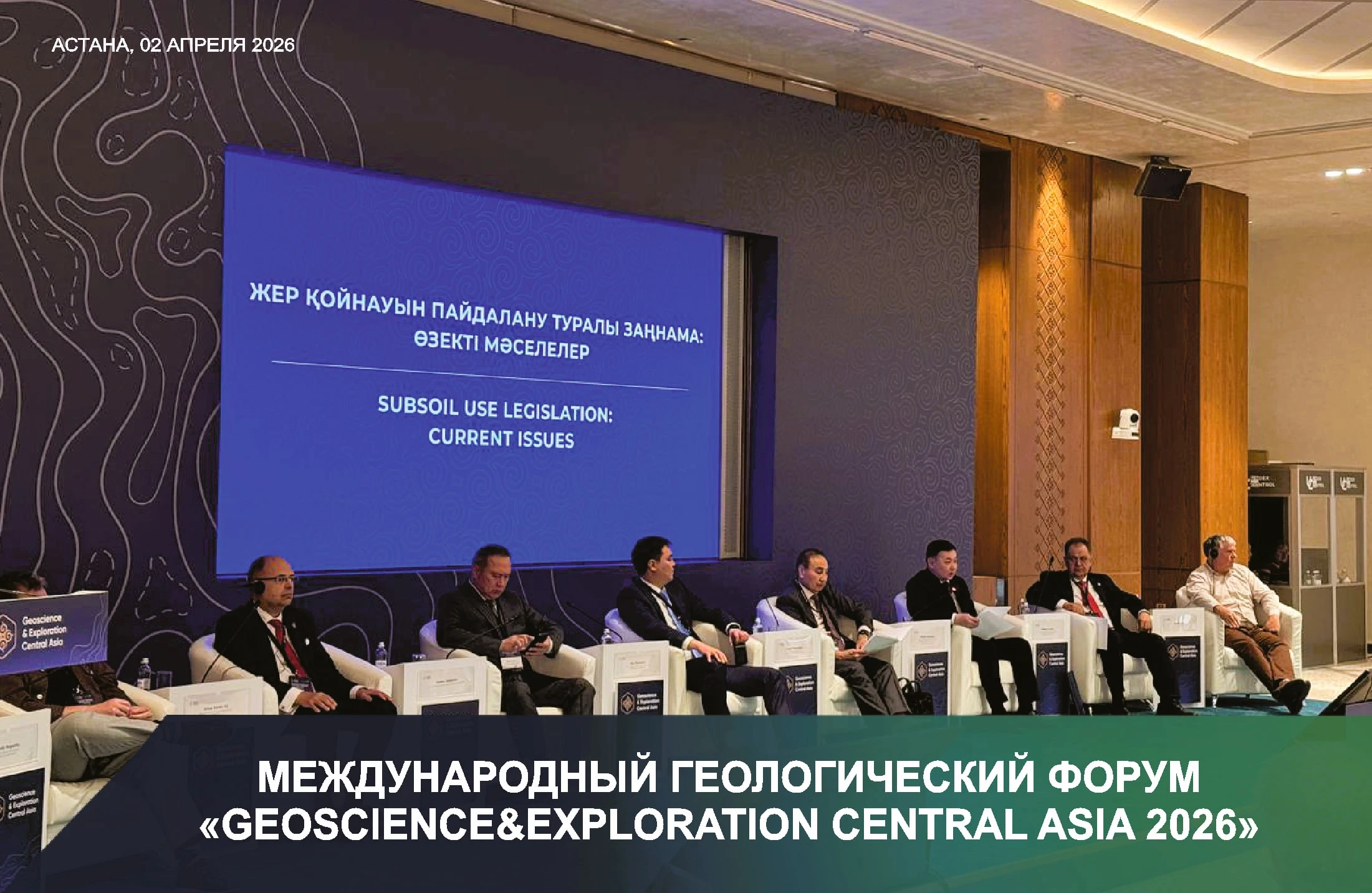
On April 2, the International Geological Forum «Geoscience & Exploration Central Asia 2026» was held in Astana, bringing together representatives of the governments of Central Asian countries, public authorities, national geological surveys, and leading industry companies. The main objective of the event was to develop strategic solutions and define long-term prospects for the development of the geological sector.
The forum opened with the panel session «Mineral Resources of Central Asia: Strategy and New Horizons», attended by the Minister of Industry and Construction of the Republic of Kazakhstan, Yersayin Nagaspayev. In his welcoming remarks, he emphasized that Central Asian countries possess significant mineral resource potential, which serves as a foundation for economic growth, industrial modernization, and energy security in the region. At the same time, the industry faces a number of serious challenges, including the depletion of traditional deposits and the need to develop resources at greater depths and in hard-to-reach areas.
He noted: «We are consistently working on the development of a modern information system that provides investors with access to up-to-date and reliable data. The digitization of archives, the implementation of big data processing technologies, and remote sensing are opening new opportunities to improve the efficiency of geological exploration».
According to him, the measures being implemented are already contributing to increased investment attractiveness, intensified exploration activities, and growing inflows of both domestic and foreign investments. Particular attention was also given to regional cooperation, as Central Asia holds strong potential for joint projects, including those related to critical raw materials.
The panel session «Digitalization, AI and New Technologies in Geology» focused on the implementation of digital solutions. Kazakhstan has accumulated a vast volume of geological data, making its systematization and digitization a priority. Previously, these archives remained largely unused, but today artificial intelligence enables their analysis and the generation of practical recommendations.
Vice Minister of Industry and Construction Zhannat Dubirova stated: «We are tasked with accelerating the digitization and systematization of geological information, primarily through the introduction of artificial intelligence. Together with the National Geological Service and Astana Hub, we are implementing a project to convert data into machine-readable formats».
In 2025, the Unified Subsoil Use Platform was launched, providing a full digital cycle from application submission to license issuance. Within the platform, 650 licenses have been issued, more than 5,500 contracts and licenses digitized, 22 public services are available, electronic auctions and an «e-wallet» service have been introduced, and access has been provided to 66,180 geological reports. The share of electronic reporting has reached 89%, significantly reducing administrative procedures.
A Big Data implementation project in geology is also underway within an acceleration program based on UAE methodology. The pilot phase has been completed, and the project is currently being implemented, with completion expected in 2028.
According to Zhannat Dubirova, in the future the system will be able to generate analytical recommendations for geologists and investors, identifying promising areas and indicating the likelihood of specific mineral deposits.
The panel session «Legislation in Subsoil Use: Current Issues» focused on regulatory changes. At the end of 2025, Kazakhstan adopted amendments to the Subsoil and Subsoil Use Code.
As noted by Vice Minister of Industry and Construction Iran Sharkhan, the law is aimed at completing ongoing reforms: it formalizes the status of the National Geological Service and the unified subsoil use portal, and removes barriers hindering industry development.
The law provides for simplified exploration procedures, including the elimination of pilot production during sampling, granting exploration rights without preliminary geological justification, introducing priority rights for strategic investors (with investments exceeding USD 100 million), and additional conditions for agreements on solid mineral processing.
In addition, a new Water Code of the Republic of Kazakhstan was adopted in 2025, aimed at ensuring water security amid climate change and growing water demand. The document establishes a transition to integrated and long-term water resource management, recognizing water as a strategic resource and an environmental component.
Vice Minister of Water Resources and Irrigation Talgat Momyshev noted that the code introduces the concept of water security for the first time and provides mechanisms to ensure it, including resource accounting and forecasting, protection of water bodies, development of science and infrastructure, and the implementation of water-saving technologies.
As part of the forum, a roundtable titled «Junior Companies: New Discoveries and Investment Potential of Central Asia» was also held, serving as a platform to present the region’s exploration potential. Participants showcased their projects and strategies to enhance asset investment attractiveness.
One of the key presentations was delivered by Takhir Kaliyev, CEO and founder of QazAurum LLP. He подробно explained the impact of the 2018 legislative reform and the transition to a licensing regime, which opened new opportunities for SMEs in exploration.
The company’s portfolio includes promising copper, gold, and antimony projects:
- Egemen copper project (100 km from Astana): drilling results confirm significant ore intersections (up to 300 m), with current resources estimated at around 370 thousand tons of copper equivalent.
- Karasuk antimony project (Aktobe region): characterized by high grades (average 6.5%, up to 31%), particularly relevant amid global demand for antimony.
- Ungurtas gold project (Almaty region): samples show gold grades up to 89 g/t, with recovery rates reaching 85.6%.
During the second day of the forum, discussions focused on the strategic role of geology, the development of the mineral resource sector, water security issues, as well as the expansion of international cooperation and the adoption of advanced technologies in geological exploration. The agenda brought together key aspects of the region’s sustainable development and outlined long-term policy priorities in the natural resources sector.
The plenary session «Geology of Central Asia: Territory of Opportunities» was dedicated to rethinking the role of geology in the socio-economic development of the region and to developing new approaches to managing mineral resources in the context of global transformations. Central Asia, and Kazakhstan in particular, possesses a unique concentration of hydrocarbon, uranium, metallic and critical mineral resources. In the current context, geology is evolving from a basic industry into a strategic instrument for ensuring economic resilience, technological advancement and the energy transition. The session highlighted key directions for national and regional policy, growth areas, investment opportunities, and the importance of international cooperation.
The discussions were further continued at the plenary session «The Role of Hydrogeology in Sustainable Water Resources Management», which placed a strong emphasis on regional water security. Despite its significant natural potential and advantageous geographical location, Central Asia faces a number of challenges, among which water and energy issues remain among the most pressing.
In the context of climate change, groundwater is increasingly viewed as a critical resource capable of ensuring sustainable water supply when managed responsibly. Kazakhstan has substantial groundwater reserves that require accurate assessment and efficient utilization. Successful experience in developing irrigated agricultural areas based on groundwater resources was highlighted in both southern and northern regions of the country, where fields of up to 2–3 thousand hectares achieved high crop yields. Experts noted that this experience could be revitalized using modern technologies.
It was also emphasized that the lack of reliable data significantly limits effective water resource management. In this regard, the introduction of a comprehensive assessment of groundwater resource potential, including mandatory mapping, was proposed as a measure to stimulate agricultural and industrial development. Additionally, the implementation of a mandatory hydro-ecological audit was proposed to prevent environmental risks and ensure a balance between environmental safety and economic development.
International dialogue continued during the open meeting of heads of geological surveys, where initiatives for cooperation with Central Asian countries were presented. Representatives from France, Finland and South Korea shared their experience and proposals on the application of modern approaches in geological exploration and geodata management.
In particular, Guillaume Bertrand, Project Manager at BRGM, spoke about the use of artificial intelligence to analyze large volumes of geological data and to produce high-resolution maps identifying promising areas for mineral exploration. Vuori Saku, Director of Science and Innovation at GTK, presented an initiative aimed at strengthening cooperation between the EU and Central Asian countries in the field of critical raw materials. Myung Jong Lee, Vice President of KIGAM, highlighted the importance of joint projects in the region and emphasized the institute’s contribution to geotechnology development and sustainable resource use.
Special attention was also given to financing and scientific cooperation. A representative of the Horizon Europe programme presented grant opportunities for mining companies, including participation in collaborative research, access to European research infrastructure, and support for innovation.
Concluding the second day’s agenda, participants discussed standardization and transparency in the industry during the KAZRC–CRIRSCO session «Public Reporting Standards for Mineral Resources and Reserves: Advancing Reporting Practices in Central Asia». The session brought together Arkady Rogalsky, Edmund Sides, Rustam Yusupov, Alexandr Kuznetsov, Alexandr Raspopov and Bekassyl Aukeshev.
Experts discussed the national KAZRC Code, as well as the application of international standards and best practices in public reporting of exploration results, mineral resources and reserves. The session served as a platform for exchanging views on the potential adoption of the CRIRSCO Template in national codes across Central Asia.
Thus, the forum confirmed the strong potential of Central Asia’s geological sector and outlined key directions for its future development, including digitalization, deeper exploration, legislative improvement, and expanded international cooperation.
The forum opened with the panel session «Mineral Resources of Central Asia: Strategy and New Horizons», attended by the Minister of Industry and Construction of the Republic of Kazakhstan, Yersayin Nagaspayev. In his welcoming remarks, he emphasized that Central Asian countries possess significant mineral resource potential, which serves as a foundation for economic growth, industrial modernization, and energy security in the region. At the same time, the industry faces a number of serious challenges, including the depletion of traditional deposits and the need to develop resources at greater depths and in hard-to-reach areas.
He noted: «We are consistently working on the development of a modern information system that provides investors with access to up-to-date and reliable data. The digitization of archives, the implementation of big data processing technologies, and remote sensing are opening new opportunities to improve the efficiency of geological exploration».
According to him, the measures being implemented are already contributing to increased investment attractiveness, intensified exploration activities, and growing inflows of both domestic and foreign investments. Particular attention was also given to regional cooperation, as Central Asia holds strong potential for joint projects, including those related to critical raw materials.
The panel session «Digitalization, AI and New Technologies in Geology» focused on the implementation of digital solutions. Kazakhstan has accumulated a vast volume of geological data, making its systematization and digitization a priority. Previously, these archives remained largely unused, but today artificial intelligence enables their analysis and the generation of practical recommendations.
Vice Minister of Industry and Construction Zhannat Dubirova stated: «We are tasked with accelerating the digitization and systematization of geological information, primarily through the introduction of artificial intelligence. Together with the National Geological Service and Astana Hub, we are implementing a project to convert data into machine-readable formats».
In 2025, the Unified Subsoil Use Platform was launched, providing a full digital cycle from application submission to license issuance. Within the platform, 650 licenses have been issued, more than 5,500 contracts and licenses digitized, 22 public services are available, electronic auctions and an «e-wallet» service have been introduced, and access has been provided to 66,180 geological reports. The share of electronic reporting has reached 89%, significantly reducing administrative procedures.
A Big Data implementation project in geology is also underway within an acceleration program based on UAE methodology. The pilot phase has been completed, and the project is currently being implemented, with completion expected in 2028.
According to Zhannat Dubirova, in the future the system will be able to generate analytical recommendations for geologists and investors, identifying promising areas and indicating the likelihood of specific mineral deposits.
The panel session «Legislation in Subsoil Use: Current Issues» focused on regulatory changes. At the end of 2025, Kazakhstan adopted amendments to the Subsoil and Subsoil Use Code.
As noted by Vice Minister of Industry and Construction Iran Sharkhan, the law is aimed at completing ongoing reforms: it formalizes the status of the National Geological Service and the unified subsoil use portal, and removes barriers hindering industry development.
The law provides for simplified exploration procedures, including the elimination of pilot production during sampling, granting exploration rights without preliminary geological justification, introducing priority rights for strategic investors (with investments exceeding USD 100 million), and additional conditions for agreements on solid mineral processing.
In addition, a new Water Code of the Republic of Kazakhstan was adopted in 2025, aimed at ensuring water security amid climate change and growing water demand. The document establishes a transition to integrated and long-term water resource management, recognizing water as a strategic resource and an environmental component.
Vice Minister of Water Resources and Irrigation Talgat Momyshev noted that the code introduces the concept of water security for the first time and provides mechanisms to ensure it, including resource accounting and forecasting, protection of water bodies, development of science and infrastructure, and the implementation of water-saving technologies.
As part of the forum, a roundtable titled «Junior Companies: New Discoveries and Investment Potential of Central Asia» was also held, serving as a platform to present the region’s exploration potential. Participants showcased their projects and strategies to enhance asset investment attractiveness.
One of the key presentations was delivered by Takhir Kaliyev, CEO and founder of QazAurum LLP. He подробно explained the impact of the 2018 legislative reform and the transition to a licensing regime, which opened new opportunities for SMEs in exploration.
The company’s portfolio includes promising copper, gold, and antimony projects:
- Egemen copper project (100 km from Astana): drilling results confirm significant ore intersections (up to 300 m), with current resources estimated at around 370 thousand tons of copper equivalent.
- Karasuk antimony project (Aktobe region): characterized by high grades (average 6.5%, up to 31%), particularly relevant amid global demand for antimony.
- Ungurtas gold project (Almaty region): samples show gold grades up to 89 g/t, with recovery rates reaching 85.6%.
During the second day of the forum, discussions focused on the strategic role of geology, the development of the mineral resource sector, water security issues, as well as the expansion of international cooperation and the adoption of advanced technologies in geological exploration. The agenda brought together key aspects of the region’s sustainable development and outlined long-term policy priorities in the natural resources sector.
The plenary session «Geology of Central Asia: Territory of Opportunities» was dedicated to rethinking the role of geology in the socio-economic development of the region and to developing new approaches to managing mineral resources in the context of global transformations. Central Asia, and Kazakhstan in particular, possesses a unique concentration of hydrocarbon, uranium, metallic and critical mineral resources. In the current context, geology is evolving from a basic industry into a strategic instrument for ensuring economic resilience, technological advancement and the energy transition. The session highlighted key directions for national and regional policy, growth areas, investment opportunities, and the importance of international cooperation.
The discussions were further continued at the plenary session «The Role of Hydrogeology in Sustainable Water Resources Management», which placed a strong emphasis on regional water security. Despite its significant natural potential and advantageous geographical location, Central Asia faces a number of challenges, among which water and energy issues remain among the most pressing.
In the context of climate change, groundwater is increasingly viewed as a critical resource capable of ensuring sustainable water supply when managed responsibly. Kazakhstan has substantial groundwater reserves that require accurate assessment and efficient utilization. Successful experience in developing irrigated agricultural areas based on groundwater resources was highlighted in both southern and northern regions of the country, where fields of up to 2–3 thousand hectares achieved high crop yields. Experts noted that this experience could be revitalized using modern technologies.
It was also emphasized that the lack of reliable data significantly limits effective water resource management. In this regard, the introduction of a comprehensive assessment of groundwater resource potential, including mandatory mapping, was proposed as a measure to stimulate agricultural and industrial development. Additionally, the implementation of a mandatory hydro-ecological audit was proposed to prevent environmental risks and ensure a balance between environmental safety and economic development.
International dialogue continued during the open meeting of heads of geological surveys, where initiatives for cooperation with Central Asian countries were presented. Representatives from France, Finland and South Korea shared their experience and proposals on the application of modern approaches in geological exploration and geodata management.
In particular, Guillaume Bertrand, Project Manager at BRGM, spoke about the use of artificial intelligence to analyze large volumes of geological data and to produce high-resolution maps identifying promising areas for mineral exploration. Vuori Saku, Director of Science and Innovation at GTK, presented an initiative aimed at strengthening cooperation between the EU and Central Asian countries in the field of critical raw materials. Myung Jong Lee, Vice President of KIGAM, highlighted the importance of joint projects in the region and emphasized the institute’s contribution to geotechnology development and sustainable resource use.
Special attention was also given to financing and scientific cooperation. A representative of the Horizon Europe programme presented grant opportunities for mining companies, including participation in collaborative research, access to European research infrastructure, and support for innovation.
Concluding the second day’s agenda, participants discussed standardization and transparency in the industry during the KAZRC–CRIRSCO session «Public Reporting Standards for Mineral Resources and Reserves: Advancing Reporting Practices in Central Asia». The session brought together Arkady Rogalsky, Edmund Sides, Rustam Yusupov, Alexandr Kuznetsov, Alexandr Raspopov and Bekassyl Aukeshev.
Experts discussed the national KAZRC Code, as well as the application of international standards and best practices in public reporting of exploration results, mineral resources and reserves. The session served as a platform for exchanging views on the potential adoption of the CRIRSCO Template in national codes across Central Asia.
Thus, the forum confirmed the strong potential of Central Asia’s geological sector and outlined key directions for its future development, including digitalization, deeper exploration, legislative improvement, and expanded international cooperation.